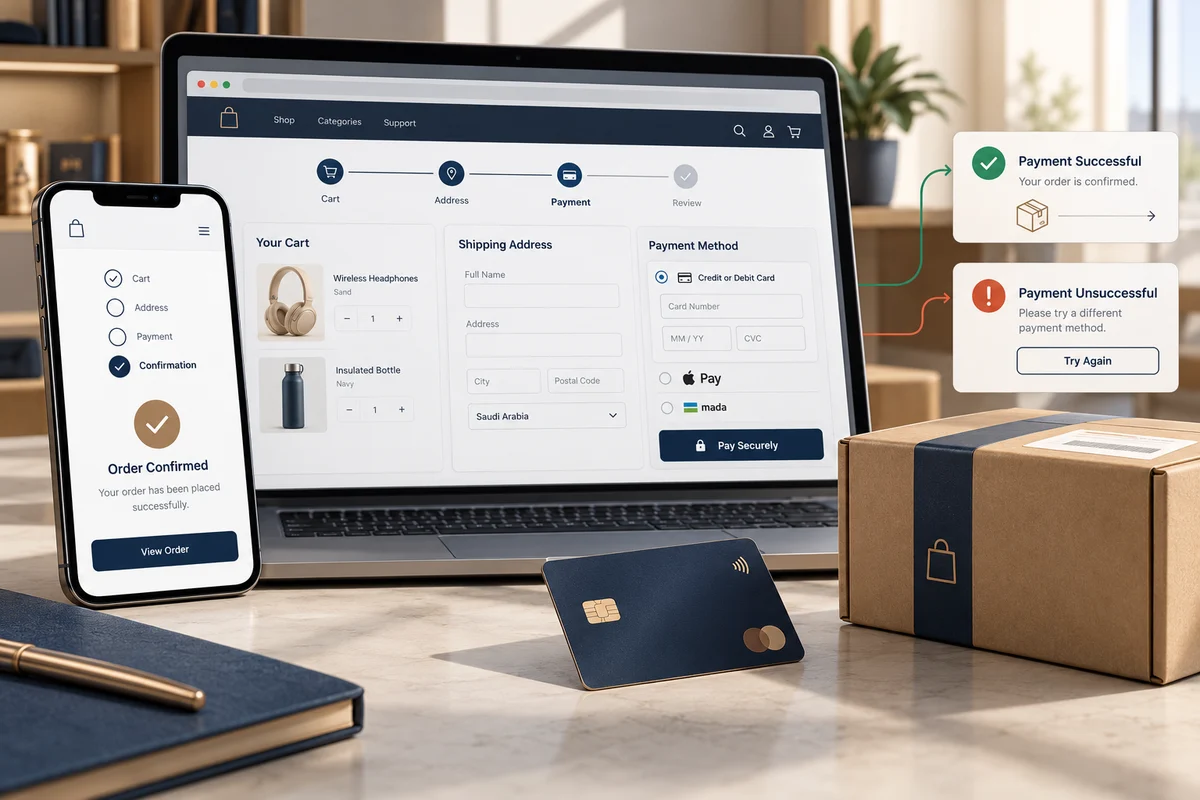

Define an event for each real step
Build a path that matches the store, such as product view, add to cart, checkout start, shipping, payment, and order placement. Google documents recommended ecommerce names including view_item, add_to_cart, begin_checkout, and purchase; use its ecommerce validation guide to inspect events. Do not treat a checkout-page view as a completed order, and define what purchase means for cash-on-delivery orders.
| Step | What to record | Measurement check |
|---|---|---|
| Product view | Item and visible variant | One event for the intended view |
| Add to cart | Item, quantity, and currency | Quantity and price match the basket |
| Checkout start | Non-personal basket or session ID | Do not fire on a generic page visit |
| Shipping/payment | Reaching the step, without sensitive fields | Do not send name, phone, or card data |
| Order placed | Unique transaction ID and order total | Refresh does not duplicate the order or event |
Make the audit reproducible
Fix the date range, channel, device, country, and product type, then define every step before reading a chart. Use GA4 Funnel Exploration; Google’s help page explains funnel steps and drop-off analysis. Keep a row for sessions reaching each step, sessions advancing, drop-off, and releases during the period. For a low-volume store, extend the window instead of making a decision from a handful of visits.
A funnel shows where counts fall, not why. Repeat the journey on mobile and desktop, and inspect response time, form errors, total charges, stock state, and payment messaging. Run one success and one failure path, then confirm the order record, not only the analytics chart.
Rank hypotheses, not impressions
Use a simple internal priority: friction severity × journeys affected × evidence confidence ÷ fix effort. This is a sorting heuristic, not a statistical score. Write a falsifiable hypothesis such as “delivery charges appear too late,” change one thing, and record the release. Review cancellations and returns alongside purchases. Do not claim improvement without a valid comparison. Connect measurement to real orders in an e-commerce development project.