
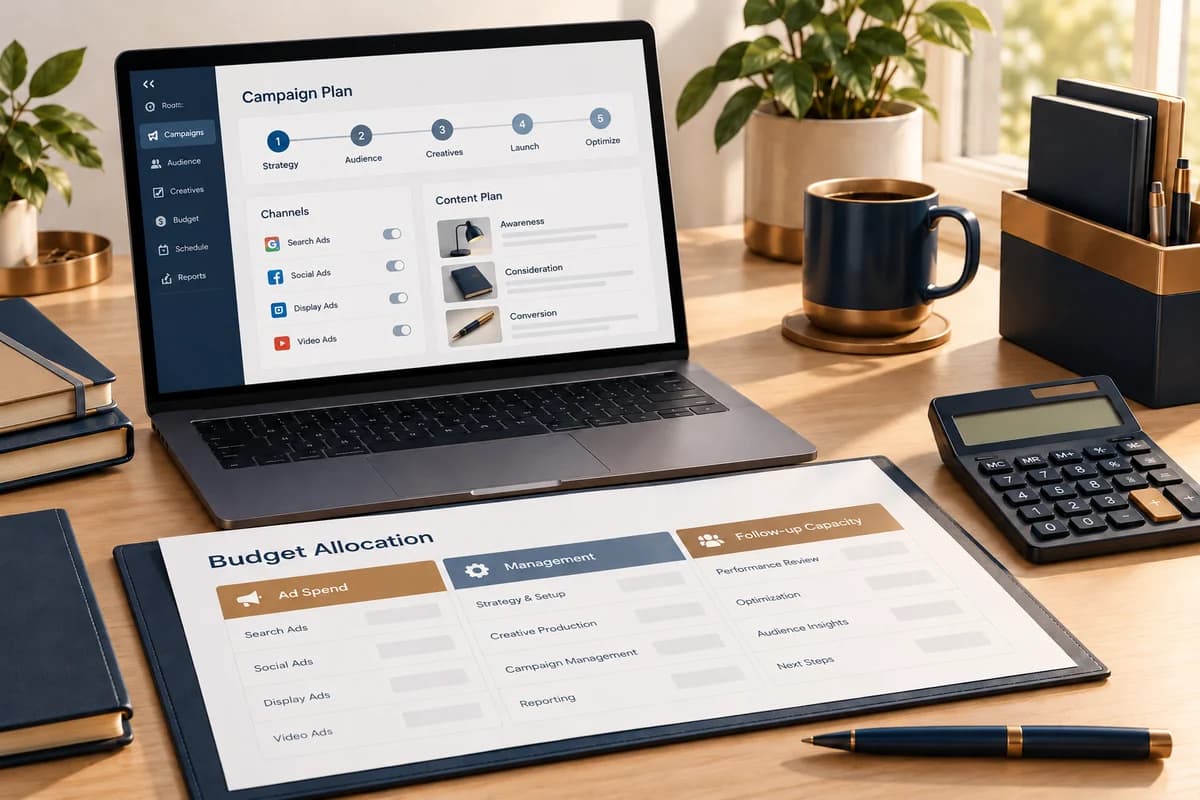
Google Ads budgeting: separate media spend from fees
Do not start with an arbitrary daily number. Separate three costs: platform spend, management and production fees, and the sales team's cost to follow up. Google treats a daily budget as an average; daily spend can vary, and billing limits depend on campaign and account settings. Review the current spending-limit guidance and budget management help before setting an acceptable ceiling.
A fictional one-month worksheet
| Assumption | Illustrative value |
|---|---|
| Media spend | EGP 8,000 |
| Assumed management fee, separate | EGP 4,000 |
| Recorded inquiries | 20 |
| Qualified inquiries | 5 |
| New customers | 1 |
| Contribution margin from that customer | EGP 10,000 |
In this hypothetical, spend plus fee is EGP 12,000 before payroll, tax and operating costs, while assumed contribution margin is EGP 10,000. Under these assumptions, the pilot does not cover its acquisition cost. This does not establish an Egypt market price or predict campaign results; the numbers are only a worked exercise.
Turn the worksheet into a decision
Calculate acquired-customer cost as total acquisition cost divided by new customers. Compare it with contribution margin after delivery cost, not gross revenue. Include capacity: if the team can start only two projects, more inquiries are not automatically better. Agree the spend ceiling, test window, qualification definition, inquiry owner and pause condition before launch.
If completed inquiries are not tracked or follow-up is slow, fix measurement and sales handling before raising budget. These assumptions are not a PROGENCY quote or performance forecast. Platform spend and fees are scoped separately in Google Ads management.