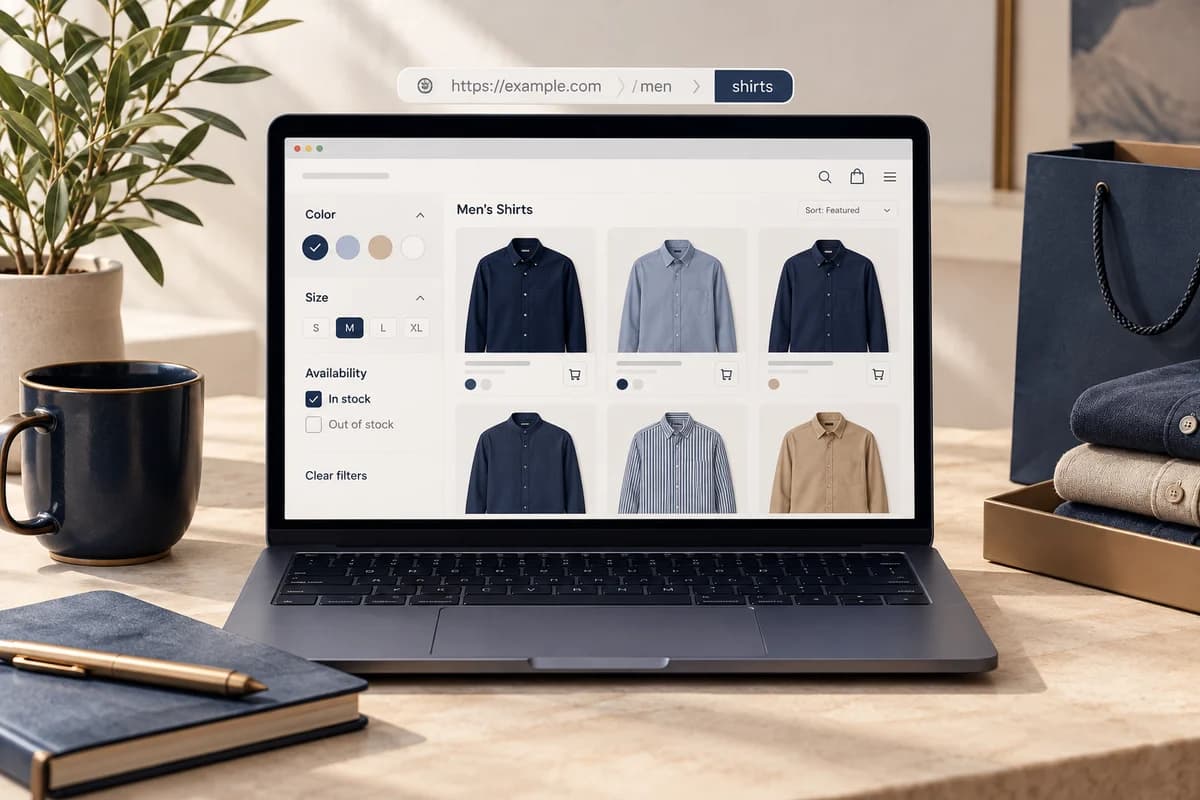
A useful filter can create an unlimited URL space
Every color, size, and sort combination may create another URL. Google’s e-commerce URL guidance recommends limiting alternate URLs with the same content. Its faceted-navigation guide explains how large filter spaces can consume crawling on low-value combinations.
| URL case | Exact example | Practical decision |
|---|---|---|
| Base category | https://shop.example.com/desks | Self-canonical, internal links, and sitemap entry |
| Intentional subcategory | https://shop.example.com/desks/material/oak | Index only if it has useful stock, content, and distinct demand; self-canonical |
| Temporary filter and sort | https://shop.example.com/desks?color=oak&sort=price-asc | Do not make every combination an SEO page; choose crawl prevention or canonical after reviewing content |
| Campaign tracking | https://shop.example.com/desks?utm_source=email | Canonical to the same clean URL without UTM |
| Impossible or empty combination | https://shop.example.com/desks?color=oak&size=nonexistent | Return a real 404, not an empty page with success status |
Canonicalization and crawl prevention solve different problems
If a crawler should fetch a near-duplicate filtered page and treat the base category as preferred, a canonical can signal that preference; Google treats it as a signal, not a guaranteed command. If filter URLs are not needed in search and crawl reduction is the goal, define robots.txt patterns and link behavior. A blocked crawler cannot read a canonical inside the blocked page, so do not combine conflicting instructions on the same URL.
If a facet has real search value, give it a stable route such as the material example, a distinct title and useful introduction, relevant stock, crawlable links, and a self-canonical. Put it in the sitemap. Do not index empty pages or automatically create pages for every sort and stock state.
A launch checklist for filters
Record parameter names, order, and duplicate normalization. Test the unfiltered category, a valuable facet, UTM, an empty combination, and pagination. Confirm product links remain crawlable and reordering parameters does not duplicate the page. These are catalog-architecture decisions; test them inside e-commerce development.